
Printed Titanium: Ever Declining Fatigue Strength
A printed part starts with lower fatigue strength than the wrought part it replaces. Over time and use, that durability gap continuously increases.
TL;DR
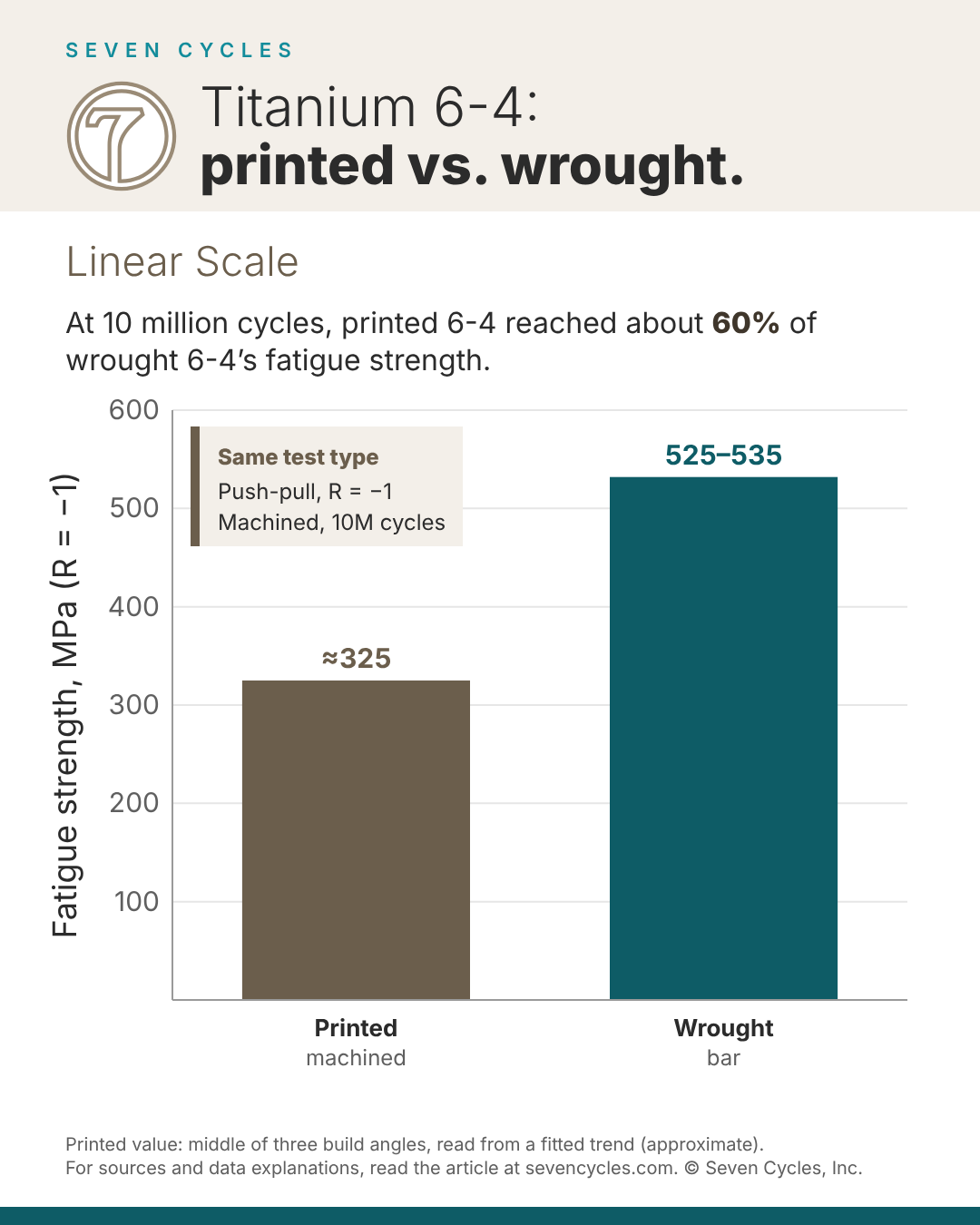
At 10 million load cycles, machined printed Ti-6Al-4V reached about 60% of wrought Ti-6Al-4V's fatigue strength. Wrought levels off. Printed keeps getting weaker as cycles add up.
“There is a significant loss of fatigue strength ... for SLM 6Al 4V titanium alloy compared with the wrought titanium alloy. The reason for this decrease is that fatigue performance is highly sensitive to pores, and these defects are inevitable in the SLM titanium alloy.”
— Sun et al., International Journal of Fatigue, 2020 Sun, Ma, Huang, Zhang & Qian, (2020). "Effects of build direction on tensile and fatigue performance of selective laser melting Ti6Al4V titanium alloy." International Journal of Fatigue, 130:105260. p 6. (Emphasis added.)
The part a printed part replaces
The majority of titanium frames are built with two alloys from two processes. The tubes are typically pilgered Ti-3Al-2.5V. The dropouts, yokes, and other small parts are usually Ti-6Al-4V, machined from wrought (rolled or forged) bar or plate. A printed part typically replaces a wrought part. So the wrought part sets the durability bar a printed part has to clear. Here we look at that bar.
This is the first article in a series on how printed titanium compares to wrought titanium, one problem at a time.
The endurance bar
Wrought 6-4 has a fatigue strength of about 530 MPa at 10 million cycles. Furuya et al. (2023). "Fatigue properties of titanium alloys disclosed in NIMS fatigue data sheets." Science and Technology of Advanced Materials: Methods. Tables 5 and 6. Printed 6-4's fatigue strength is about 325 MPa, roughly 60% of wrought. Qian, Li, Paolino, Tridello, Berto & Hong, (2020). "Very-high-cycle fatigue behavior of Ti-6Al-4V manufactured by selective laser melting: Effect of build orientation." International Journal of Fatigue, 136:105628. The charts below explain.
“All the cracks initiated from the internal of the specimens in both HCF and VHCF regimes. ... This may be due to the fact that a large number of internal porosity and lack of fusion exist inside the specimens manufactured by SLM.”
— Qian et al., International Journal of Fatigue, 2020 Qian, Li, Paolino, Tridello, Berto & Hong (2020). "Very-high-cycle fatigue behavior of Ti-6Al-4V manufactured by selective laser melting: Effect of build orientation." International Journal of Fatigue, 136:105628. p 13.
What the data shows
In this article we look at testing from a 2020 paper by Qian, Li, Paolino, Tridello, Berto & Hong: Very-high-cycle fatigue behavior of Ti-6Al-4V manufactured by selective laser melting: Effect of build orientation. Qian, Li, Paolino, Tridello, Berto & Hong, (2020). "Very-high-cycle fatigue behavior of Ti-6Al-4V manufactured by selective laser melting: Effect of build orientation." International Journal of Fatigue, 136:105628. We also draw on several supporting papers listed in the footnotes.
Animation: Printed vs. Wrought Bar
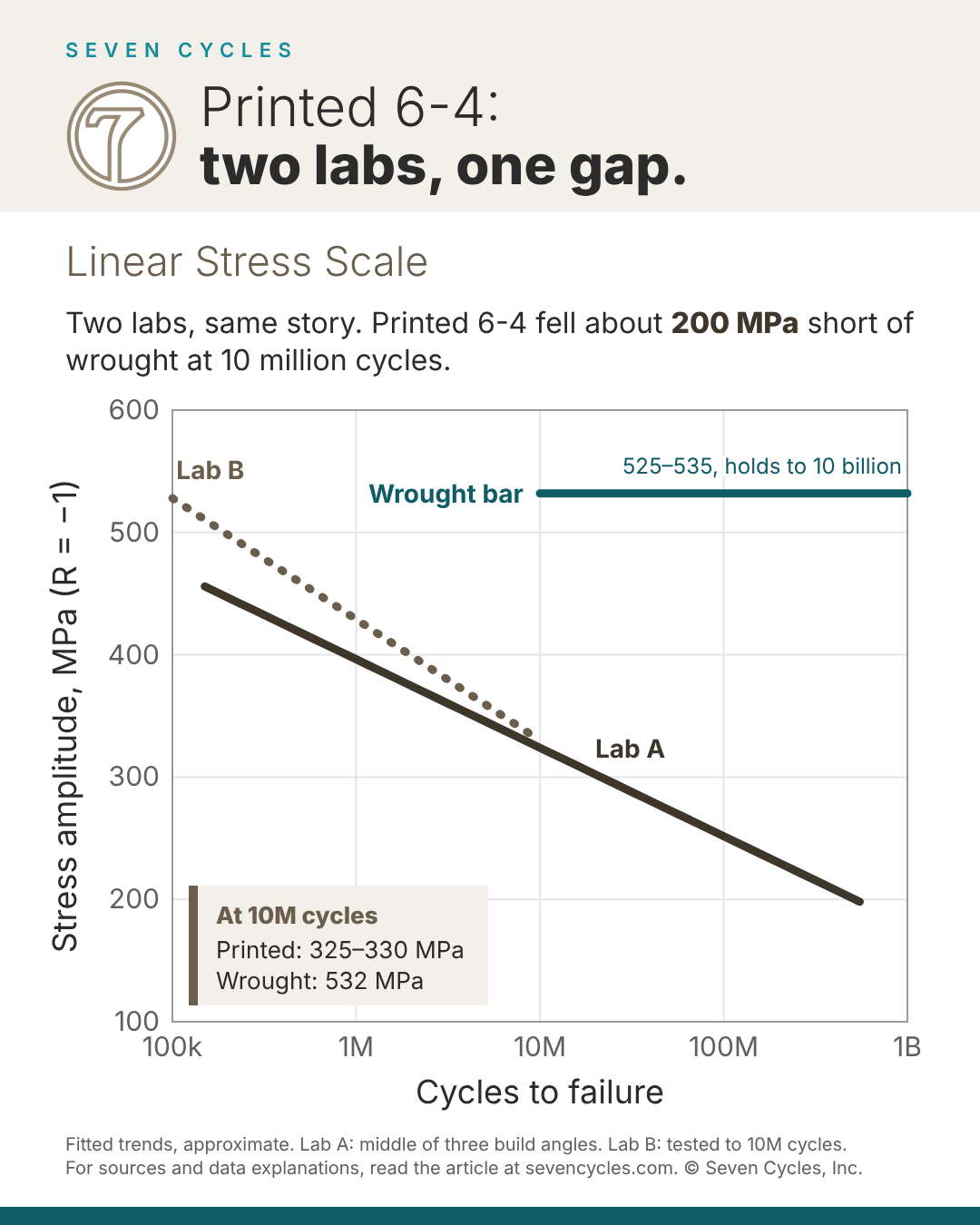
Two labs, both publishing in 2020, found printed 6-4 about 38 percent below wrought at 10 million cycles. Qian, Li, Paolino, Tridello, Berto & Hong, (2020). "Very-high-cycle fatigue behavior of Ti-6Al-4V manufactured by selective laser melting: Effect of build orientation." International Journal of Fatigue, 136:105628. At 10 million cycles (a common cutoff for measuring fatigue strength), wrought bar held 525-535 MPa. Printed parts held about 325 MPa. That's about 61% of wrought. To provide some perspective, pedaling for 10 million revolutions at 90 rpm takes about 1,850 hours. (Of course this is not exactly how a bike frame gets fatigued, but the illustration provides context.)
Printed titanium 6-4: two labs, one gap.
“Porosity is one of the most critical inevitable defects due to the complexity of the SLM process.”
— Sun et al., International Journal of Fatigue, 2020 Sun, Ma, Huang, Zhang & Qian, (2020). "Effects of build direction on tensile and fatigue performance of selective laser melting Ti6Al4V titanium alloy." International Journal of Fatigue, 130:105260. p 1.
About the pedaling times under the animation and chart II and III. The "cycles to failure" axis is logarithmic: each gridline is 10 times the one before. That compresses huge differences into short distances. To make the scale easier to grasp, each cycle count also carries the time it would take to turn the cranks that many times at 90 rpm, without ever stopping. Ten million cycles is about 77 days. A billion is about 21 years. (Again, this is not exactly how a bike frame gets fatigued, but the illustration provides context.)
Chart I: Printed vs. Wrought Bar
At 10 million cycles, wrought bar held 525-535 MPa. Furuya et al. (2023). "Fatigue properties of titanium alloys disclosed in NIMS fatigue data sheets." Science and Technology of Advanced Materials: Methods. Tables 5 and 6. Printed parts held about 325 MPa. That's about 61% of wrought.
“The fatigue crack origin has been found to be always an internal defect both at high-cycle fatigue and VHCF (very high cycle fatigue) regime”
— Qian et al., International Journal of Fatigue, 2020 Qian, Li, Paolino, Tridello, Berto & Hong (2020). "Very-high-cycle fatigue behavior of Ti-6Al-4V manufactured by selective laser melting: Effect of build orientation." International Journal of Fatigue, 136:105628. p 1.
Titanium 6-4: printed vs. wrought
Titanium 6-4: printed fades
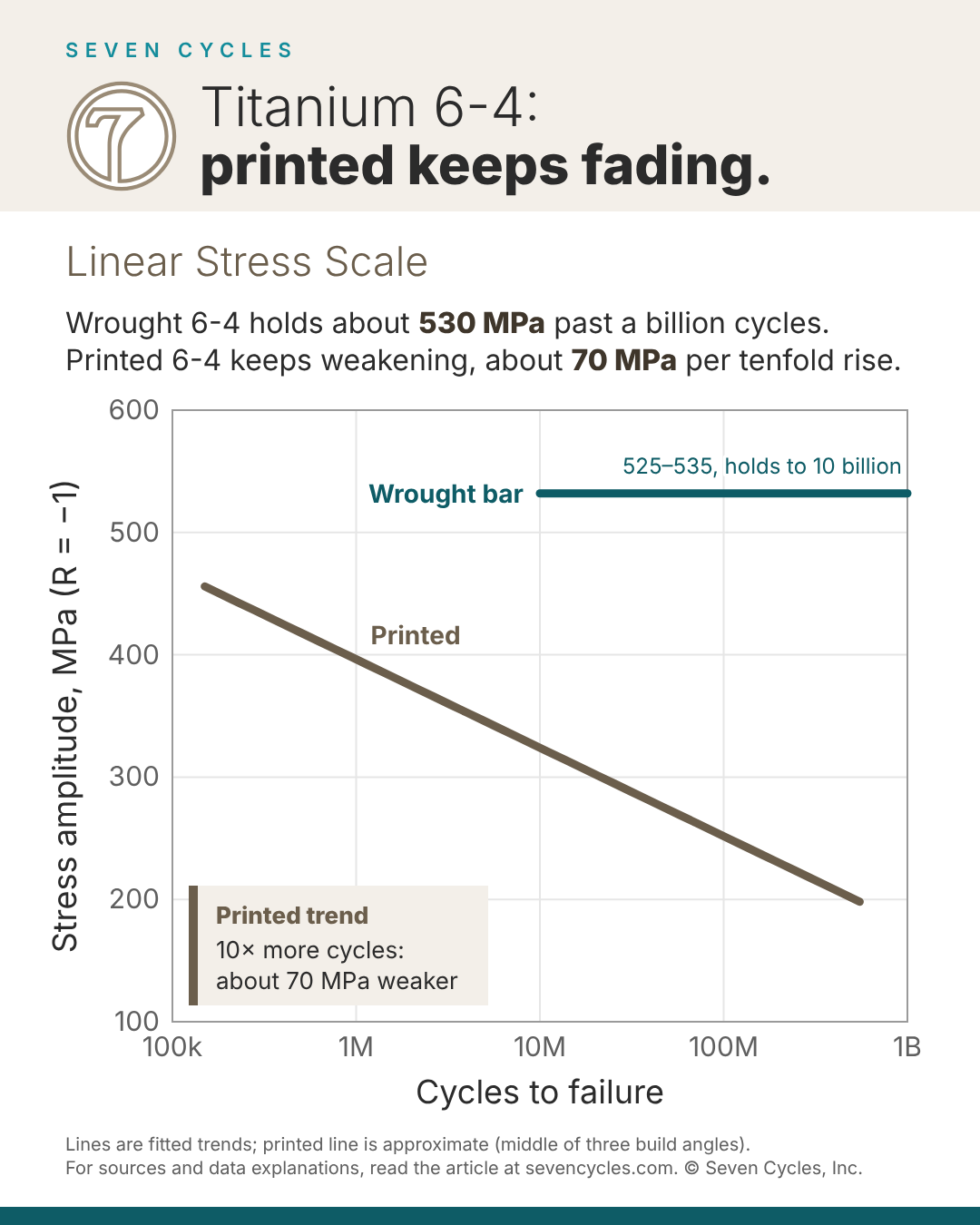
Chart II: Printing Fades
Fatigue strength of wrought Ti-6Al-4V levels off overtime. Its strength at 10 billion cycles matched its strength at 10 million. Furuya et al. (2023). "Fatigue properties of titanium alloys disclosed in NIMS fatigue data sheets." Science and Technology of Advanced Materials: Methods. Tables 5 and 6. The printed trend line never levels off, out to the 500 million cycles tested. Qian, Li, Paolino, Tridello, Berto & Hong, (2020). "Very-high-cycle fatigue behavior of Ti-6Al-4V manufactured by selective laser melting: Effect of build orientation." International Journal of Fatigue, 136:105628. Each tenfold increase in cycles cost about 70 MPa. Because the cycles axis is logarithmic, that steady loss draws as a straight line. Extended to 1 billion cycles, the printed line might reach about 180 MPa, roughly a third of wrought.
This is a measuring stick, not a riding scenario. A frame's load cycles also come from rough terrain, braking, and sprints, at many different stresses, not one steady pedal load. What the fatigue cycles do show is proportion. The last printed specimen broke near 540 million cycles. Qian, Li, Paolino, Tridello, Berto & Hong, (2020). "Very-high-cycle fatigue behavior of Ti-6Al-4V manufactured by selective laser melting: Effect of build orientation." International Journal of Fatigue, 136:105628. (About 11 years of nonstop pedaling.) The wrought specimens were still intact at 10 billion cycles (about 211 years). Furuya et al. (2023). "Fatigue properties of titanium alloys disclosed in NIMS fatigue data sheets." Science and Technology of Advanced Materials: Methods. Tables 5 and 6.
Chart III: Two Tests Agree
A second lab agrees. Sun and colleagues tested printed Ti-6Al-4V the same way. Sun, Ma, Huang, Zhang & Qian, (2020). "Effects of build direction on tensile and fatigue performance of selective laser melting Ti6Al4V titanium alloy." International Journal of Fatigue, 130:105260. Their best build direction reached about 330 MPa at 10 million cycles. That's within about 5 MPa of the first lab, and about 200 MPa (38%) short of wrought.
“The range of stress amplitude... regimes varies from 200 to 500 MPa and a fatigue limit does not appear.”
— Qian et al., International Journal of Fatigue, 2020 Qian, Li, Paolino, Tridello, Berto & Hong, (2020). "Very-high-cycle fatigue behavior of Ti-6Al-4V manufactured by selective laser melting: Effect of build orientation." International Journal of Fatigue, 136:105628. p 8. (Emphasis added.)
Why it matters for bike frames
A frame collects load cycles for as long as it's ridden. Every pedal stroke, impact, and sprint adds more. A wrought dropout that survives the first 10 million cycles at a given stress should survive the next billion. A printed dropout at the same stress keeps losing margin.
Printed titanium 6-4: two labs, one gap
“Fatigue strength of SLM materials at 106 cycles were over 75% lower than that of wrought material.”
— Sun et al., International Journal of Fatigue, 2020 Sun, Ma, Huang, Zhang & Qian, (2020). "Effects of build direction on tensile and fatigue performance of selective laser melting Ti6Al4V titanium alloy." International Journal of Fatigue, 130:105260. p 2.
Solutions
A partial practical fix is to increase printed part size and cross-section area. A printed part needs more material to keep its stress low enough. Unfortunately that adds weight, but lightweight is often touted as a primary reason the part was printed in the first place. Even when the parts look about the same size or surface area of a wrought machined part, the interior of printed parts is almost always hollow. So, physical size is not a reliable signal of print durability.
None of this makes printed parts unsafe by default. It does mean the engineering numbers for wrought material don't transfer to printed parts. A printed part has to be designed and tested, as its own material. Very few builders have the means, inclination, or capital to do this complex and time consuming testing.
| Material | Source | At 10M cycles (MPa) | % of wrought at 10M | At 1B cycles (MPa) |
|---|---|---|---|---|
| Printed Ti‑6Al‑4V, Lab A 45° build (middle of three), machined | Qian et al., 2020 Qian, Li, Paolino, Tridello, Berto & Hong, (2020). "Very-high-cycle fatigue behavior of Ti-6Al-4V manufactured by selective laser melting: Effect of build orientation." International Journal of Fatigue, 136:105628. | ≈325 | ≈61% | ≈180* |
| Printed Ti‑6Al‑4V, Lab B upright build (stronger of two) | Sun et al., 2020 Sun, Guo, Paolino, Tridello, Berto & Hong, (2020). "Very-high-cycle fatigue behavior of Ti-6Al-4V manufactured by selective laser melting: Effect of build orientation." International Journal of Fatigue, 130:105260. | ≈330 | ≈62% | not tested |
| Wrought Ti‑6Al‑4V bar hot-rolled, 900 MPa class, 600 grit finish | Furuya et al. (NIMS), 2023 review of data first published 2000 and 2003 Furuya et al. (2023). "Fatigue properties of titanium alloys disclosed in NIMS fatigue data sheets." Science and Technology of Advanced Materials: Methods. | 525–535 | 100% | 525–535 (holds to 10B) |
Caveats
- Printed values are approximate. We read them from the fitted trend lines in Qian's Figure 5, not from a data table. Qian, Li, Paolino, Tridello, Berto & Hong, (2020). "Very-high-cycle fatigue behavior of Ti-6Al-4V manufactured by selective laser melting: Effect of build orientation." International Journal of Fatigue, 136:105628.
- Heat treatment varies. Qian doesn't state one. Sun's parts were annealed at 750–850 °C, Furuya et al. (2023). "Fatigue properties of titanium alloys disclosed in NIMS fatigue data sheets." Science and Technology of Advanced Materials: Methods. Tables 5 and 6. hotter than the stress relief most bike parts get. Neither used HIP (hot isostatic pressing), which bike builders also don't use.
- Different test machines. Qian tested at 20,000 cycles per second; Sun at 20; the wrought data at 120. All three were fully reversed axial loading (R = −1).
- Wrought means bar. The wrought data come from hot-rolled bar, not dropout plate. Both are wrought Ti-6Al-4V with very similar properties.
- Data dates. Both printed studies were published in 2020. The wrought data come from a 2023 review of the Japanese National Institute for Materials Science (NIMS) fatigue data sheets; those tests were first published in 2000 and 2003. Original NIMS data sheets behind the 2023 review: Fatigue properties of Ti-6Al-4V (900 MPa class) titanium alloy, NRIM fatigue data sheet No. 85 (2000) "Giga-cycle fatigue properties of Ti-6Al-4V (900 MPa class) titanium alloy." NIMS fatigue data sheet No. 92 (2003). The age of the wrought data matters less than it might seem. Wrought Ti-6Al-4V bar, and the way it's made, has changed little in decades, so its fatigue strength hasn't moved. Printing is the process that keeps changing, which is why the printed data here is recent.
- A third lab agrees, on a relative scale. Chastand and colleagues found stress-relieved printed parts "at the level of casting"; Chastand, Quaegebeur, Maia & Charkaluk (2018). "Comparative study of fatigue properties of Ti-6Al-4V specimens built by EBM and SLM." Materials Characterization. 143:76–81. Chastand et al. (2016), "Fatigue characterization of titanium Ti-6Al-4V samples produced by additive manufacturing." Procedia Structural Integrity. 2:3168–3176. wrought sat well above. Their charts don't give MPa, so they aren't plotted here.
Charts redrawn by Seven Cycles.